
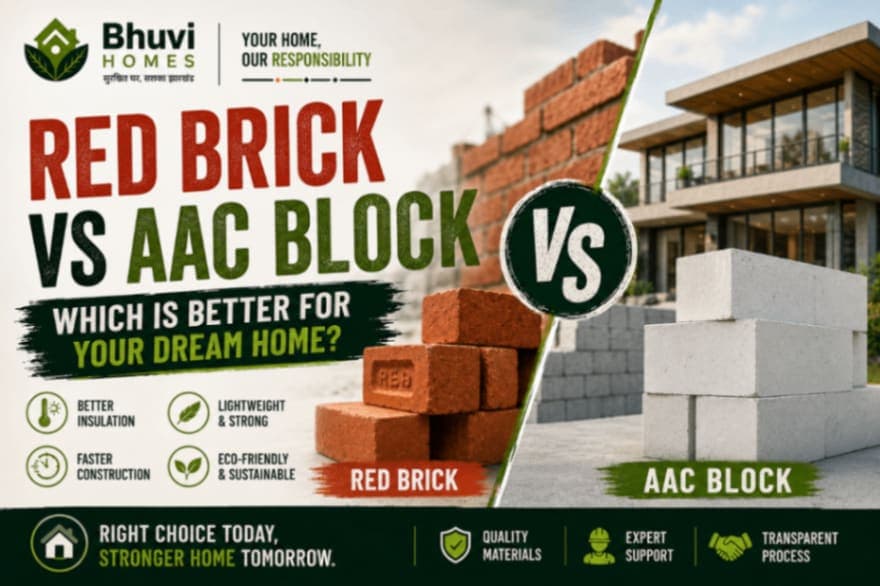
🧱 Red Brick vs AAC Block: Which is Better for Your Dream Home?
Choosing the right wall material is one of the most important decisions when building your dream home. While many homeowners still prefer traditional red bricks, modern construction is rapidly shifting towards AAC blocks due to their superior performance and efficiency.
In this guide, we'll compare Red Bricks and AAC Blocks in detail to help you make an informed decision for your dream home.
🏡 What Are Red Bricks?
Red bricks are traditional building materials made from clay and fired in kilns at high temperatures. They have been used for centuries in residential and commercial construction.
Advantages of Red Bricks
✅ Easily available
✅ Good compressive strength
✅ Familiar construction method
✅ Suitable for small and traditional projects
Limitations of Red Bricks
❌ Higher dead load on the structure
❌ Requires more mortar and plaster
❌ Poor thermal insulation
❌ Greater water absorption
❌ Consumes fertile soil during manufacturing
🏗️ What Are AAC Blocks?
AAC (Autoclaved Aerated Concrete) Blocks are lightweight precast building materials made from cement, lime, sand, water, and a small amount of aluminum powder.
AAC blocks contain millions of tiny air pockets, making them lightweight and highly energy-efficient.
Advantages of AAC Blocks
✅ Lightweight construction
✅ Excellent thermal insulation
✅ Better sound insulation
✅ Faster construction speed
✅ Reduced structural load
✅ Eco-friendly material
✅ Better dimensional accuracy
📊 Red Brick vs AAC Block: Detailed Comparison
| Factor | Red Brick | AAC Block |
|---|---|---|
| Weight | Heavy | Lightweight |
| Construction Speed | Slower | Faster |
| Thermal Insulation | Moderate | Excellent |
| Sound Insulation | Average | Better |
| Water Absorption | Higher | Lower |
| Mortar Requirement | More | Less |
| Structural Load | Higher | Lower |
| Eco-Friendliness | Lower | Higher |
| Finish Quality | Average | Better |
| Cost Efficiency | Moderate | Higher Long-Term Savings |
🌡️ Which Material Keeps Your Home Cooler?
One of the biggest advantages of AAC blocks is thermal insulation.
Because AAC blocks contain air pockets, they reduce heat transfer significantly. During hot summers, homes built with AAC blocks tend to stay cooler compared to homes constructed with traditional red bricks.
This can reduce dependence on air conditioning and help lower electricity bills. 💡
💰 Which Option Is More Cost-Effective?
Many homeowners look only at the initial material cost. However, construction costs should be evaluated over the entire project lifecycle.
AAC blocks often help save money through:
✔ Reduced steel consumption due to lower structural load
✔ Lower mortar usage
✔ Faster construction
✔ Reduced plaster thickness
✔ Lower cooling costs in the future
Although the per-unit cost may sometimes appear higher, AAC blocks often provide better overall value.
🌱 Environmental Impact
Sustainable construction is becoming increasingly important.
AAC blocks are considered more environmentally friendly because they:
🌿 Use fewer natural resources
🌿 Generate less construction waste
🌿 Improve building energy efficiency
🌿 Reduce carbon footprint over time
Traditional brick manufacturing often consumes fertile topsoil and requires high-temperature kiln firing.
🏠 Which Material Should You Choose?
Choose Red Bricks If:
✔ You prefer traditional construction methods
✔ Local labor is more experienced with brick masonry
✔ The project is small-scale
Choose AAC Blocks If:
✔ You want a modern and energy-efficient home
✔ Faster construction is important
✔ You want better thermal comfort
✔ You are looking for long-term savings
✔ Sustainability matters to you
⭐ Expert Recommendation
For most modern residential projects, AAC blocks offer significant advantages in terms of weight, insulation, speed of construction, and long-term cost savings.
However, the best choice depends on your project requirements, budget, location, and structural design. Consulting experienced construction professionals before finalizing materials is always recommended.
A well-built home is not just about appearance—it starts with choosing the right materials for strength, comfort, and durability.
❓ Frequently Asked Questions (FAQ)
1. Are AAC blocks stronger than red bricks?
AAC blocks provide adequate strength for residential construction and meet modern building standards. Structural design should always be done according to engineering requirements.
2. Do AAC blocks reduce electricity bills?
Yes. AAC blocks provide better thermal insulation, which helps maintain indoor temperatures and can reduce cooling costs.
3. Are AAC blocks more expensive than red bricks?
The initial material cost may vary depending on location, but AAC blocks often reduce overall construction expenses through savings in steel, mortar, plaster, and energy consumption.
4. Do AAC blocks absorb water?
AAC blocks generally have lower water absorption compared to traditional bricks when installed and protected properly.
5. Which material is better for a modern house?
AAC blocks are generally preferred for modern homes because they are lightweight, energy-efficient, eco-friendly, and help speed up construction.
6. Can AAC blocks be used in multi-story buildings?
Yes. AAC blocks are widely used in residential, commercial, and multi-story construction projects across India.
Planning to build your dream home? Connect with Bhuvi Homes for transparent construction, expert guidance, premium materials, and end-to-end project management. Let's turn your vision into a home built to last. 🏡✨