

Vastu House Construction Tips: Align Your Home with Nature
Think of the last time you walked into a house and felt calm within seconds. The light was soft, the air felt fresh, and nothing felt cramped.
Now think of another house where you felt tired or restless for no clear reason.
Usually it isn’t the paint or the furniture. It’s how the space was built. when someone felt negativity in your house they said “Ghar ka Vastu sahi nahi hai”,
so if going direct dive into the how vastu work, first understand the what is Vastu?
That feeling is exactly what Vastu Shastra has studied for thousands of years.
What Is Vastu?
Vastu is the traditional Indian science of building a home that fits with nature, the elements, and the people living in it. Your house isn’t treated as four walls and a roof. It’s treated as a living space that should support your body, your mind and your daily life.
Vastu looks at the land, the sun, the wind, the direction of every room, and how each space makes you feel. That’s why it’s so wide-ranging. It connects with astrology, Ayurveda, yoga and our ancient scriptures. Let’s look at each of these.
The Essence(सार) of Vastu Shastra
Vastu Shastra (वास्तु शास्त्र) literally means the “science of dwelling”. It is based on ancient Sanskrit texts and is deeply rooted in Hindu tradition. The goal is to create buildings aligned with nature’s elements,
- Earth (Prithvi): stability and strength
- Water (Jal): flow and freshness
- Fire (Agni): energy and warmth
- Air (Vayu): movement and breath
- Space (Akash): openness and peace
so occupants enjoy health, wealth and happiness.
In practice, this means considering the sun’s path, wind directions, magnetic fields and even planetary energies when planning a house.
In recent years many Indians have revisited Vastu rules, finding that some guidelines (like maximizing natural light and ventilation) are indeed practical and “scientific.” Others see Vastu as reinforcing family traditions or faith. However, experts advise a balanced approach: know the principles but apply them wisely.
- Traditional view: Vastu ties the five elements (Panchabhutas) to building design. Each direction has symbolic significance (Example : North for prosperity(समृद्धि), East for health).
- Modern view: Use Vastu as a guideline rather than a strict formula. For example, ensure your home gets morning light (East), avoid dark, damp corners (North-East), and keep the center open for good energy.
Land and Plot Selection
When selecting a plot of land, two factors are taken into consideration: which land should be chosen according to Vastu Shastra, and which should not.
Good Plot Section
- Plot Shape: Ideal plots are square or rectangular. Rectangular plots with the longer side facing East or North are fine.
- Gaumukhi: According to Vastu, a ‘Gaumukhi’ plot refers to a piece of land that is narrow at the front and wide at the back. Its shape is considered to resemble the face of a cow—hence the name ‘Gaumukhi’ (cow-faced). In traditional Vastu, such a plot is considered auspicious(शुभ) for a home.
- Plot Orientation & Slope: Good sites have natural slope towards the North or East (helps drain water naturally).
- Surroundings: A road to the North or East of the plot is auspicious(शुभ). For water, flowing drains or rivers from South→North or West→East are good (water on NE is best).
- Setbacks (Open Space): Leave more open space on the North and East sides of the building. This allows air and light from the auspicious(शुभ) sides (N/E). In any case, always maintain a small gap around the house for ventilation, rainwater access and maintenance.
Bad Plot Section(Must Avoid)
- Shape: Avoid “bagh mukhi” plots (front much wider than back) or irregular shapes, as they distort energy flow. Also avoid plots longer on the south-west side.
- Orientation & Slope: Avoid land that slopes down to the south or west. If the plot has a dip in the middle, fill or level it – depressions in the center attract negative energy.
- Surroundings: Roads on South or West are less ideal. For water, water flow from East→West or South→North is considered unstable. Avoid land near crematories, hospitals, or temples that cast shadows on the plot. Tall trees casting long shadows (especially on NE) are avoided.
How Strictly Should You Follow Vastu?
Vastu is very detailed – some texts have hundreds of rules, considering birth charts, food habits and more. In practice, most homeowners do a partial Vastu check:
Discuss with your architect: If you strongly believe in Vastu, hire an architect who respects it. Get the initial design done, then have a Vastu expert review the plan. After that, tweak the floor plan per the consultant’s suggestions before finalizing.
Plot vs. design: Earlier, choosing the perfect plot (shape, slope, surroundings) was key. Now in Jharkhand’s expanding cities, ideal land is rare or costly. So more focus is on orienting the design and interiors. For example, if your plot isn’t perfectly square or faces South, you can still optimize the interior layout.
Practical balance: Don’t compromise safety or comfort just for Vastu. For instance, if the “ideal” location for the kitchen (south-east corner) means building over a septic line, it’s better to adapt. Use common sense (and an expert opinion) to find workable compromises.
Vastu Directions, Elements and Room Placements
It is essential to have knowledge of the cardinal directions before building a house.
Every direction is associated with certain elements, deities and recommended uses in Vastu. The table below summarizes the 8 cardinal and intercardinal directions plus the center (Brahmasthan). Use this as a quick reference when planning rooms and decor:
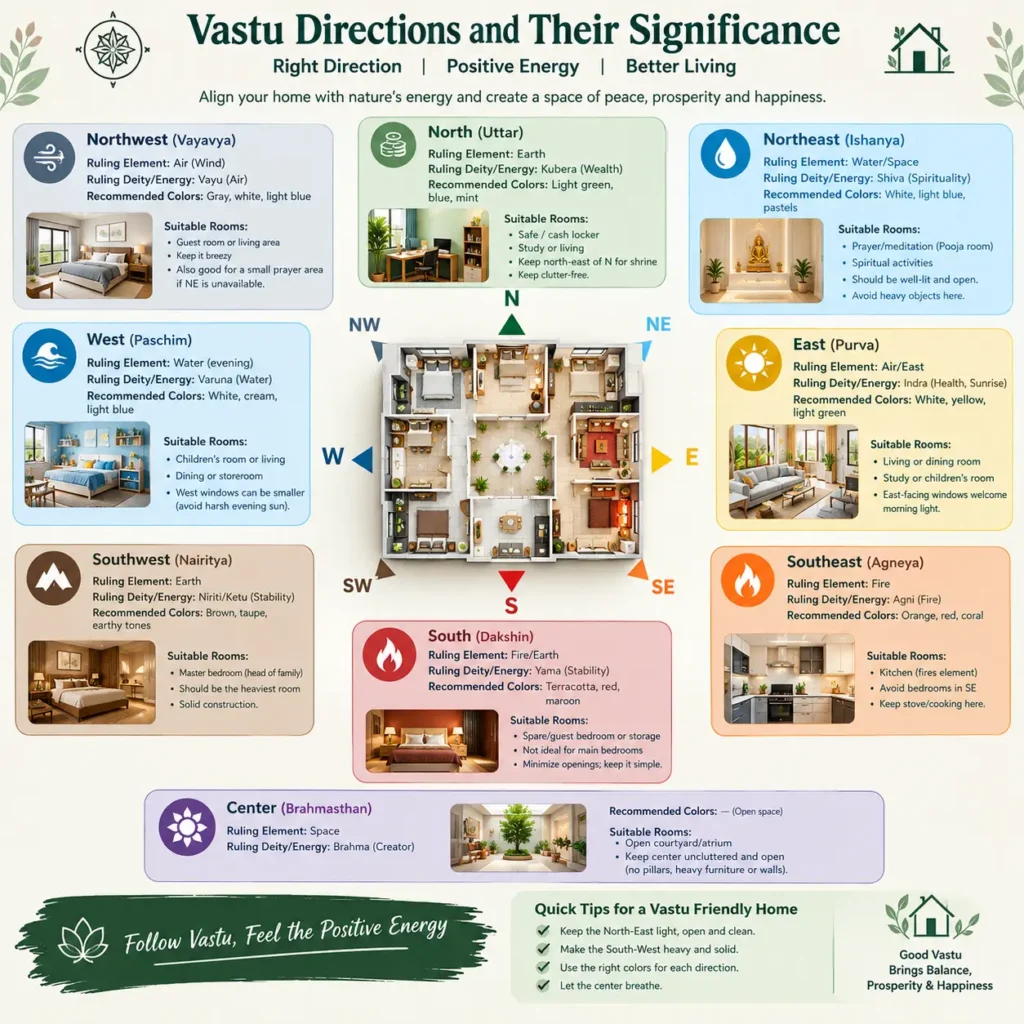
| Direction | Ruling Element | Ruling Deity/Energy | Recommended Colors | Suitable Rooms (Placement) |
|---|---|---|---|---|
| North (Uttar) | Earth | Kubera (Wealth) | Light green, blue, mint | Safe/cash locker, study or living; north-east of N for shrine; keep clutter-free. |
| Northeast (Ishanya) | Water/Space | Shiva (Spirituality) | White, light blue, pastels | Prayer/meditation (Pooja room); spiritual activities; should be well-lit and open. Avoid heavy objects here. |
| East (Purva) | Air/East | Indra (Health, Sunrise) | White, yellow, light green | Living or dining room to welcome morning sun; study or children’s room. East-facing windows welcome light. |
| Southeast (Agneya) | Fire | Agni (Fire) | Orange, red, coral | Kitchen (fires element); avoid bedrooms in SE. Keep stove/cooking here. |
| South (Dakshin) | Fire/Earth | Yama (Stability) | Terracotta, red, maroon | Spare/guest bedroom or storage; not ideal for main bedrooms. Minimize openings; keep south rooms simple. |
| Southwest (Nairitya) | Earth | Niriti/Ketu (Stability) | Brown, taupe, earthy tones | Master bedroom (head of family) for stability and authority. Should be the heaviest room with solid construction. |
| West (Paschim) | Water (evening) | Varuna (Water) | White, cream, light blue | Children’s room or living (south-west corner for family); dining or storeroom. West windows can be smaller (avoid harsh evening sun). |
| Northwest (Vayavya) | Air/Wind | Vayu (Air) | Gray, white, light blue | Guest room or living area; keep it breezy. North-west also suits a small prayer area or puja if NE is unavailable. |
| Center (Brahmasthan) | Space | Brahma (Creator) | — (Open space) | Open courtyard/atrium. Keep center uncluttered and open (no pillars, heavy furniture or walls) for good energy flow. |
This table combines traditional colors and uses. For example, since North is tied to Kubera (wealth), it’s advised to keep valuables (like cash or safe) in the north side. The northeast (Ishanya) is the “wisdom corner” – ideal for a puja room or meditation corner. The southwest is ruled by Earth (Nairiti), so master bedrooms or heavy stuff go there.
Room-by-Room Vastu Tips
Use the cardinal directions to place the following rooms wherever practical:
- Living Room (Drawing Room): Living Room should be in the Northeast, North, East or Northwest part of the house. These sides get good light and flow. A North-West living room is acceptable if NE isn’t available. Keep it open and airy. Heavy furniture should be placed in the South or West areas of the living room (so it doesn’t block the light from East/North). Windows should face North or East if possible, and electronics (TV, stereo) can go in the SouthEast corner of the living area.
- Kitchen: The fire element of the kitchen aligns with the SouthEast direction (Agni corner). Put the stove/cooking counter in the SouthEast or at least have it face East. The person cooking should ideally face east or north while cooking (not south) to harness positive energy. Avoid kitchens in the NorthEast or SouthWest corners. The sink (water) is best placed in the NorthEast part of the kitchen (water-west-fire-east rule).
Tip: Kitchen should not have common wall with Toilet, Kitchen Door and Toilet Door should not facing eatchother
- Master Bedroom: Prefer the SouthWest corner of the home for the master bedroom. This is consistent with tradition: parents or heads of family sleep in SW for stability. According to AD, “a bedroom in a South-West direction brings good health and prosperity”. In a SW room, place the bed so the head points south or west (avoid north). Avoid having a bathroom or stairs attached to this bedroom.
- Other Bedrooms: If possible, place children’s or guest bedrooms in the NorthWest or South parts of the house. North or East bedrooms are suitable for children or studying. Avoid bedrooms in the NorthEast.
- Tip : Do not hang mirrors in front of the bed. Avoid water-related decor (like aquarium) in a bedroom.
- Staircase: The ideal location for stairs is in the southwest, south or west part of the house. Avoid stairs in the northeast, east or north. When counting steps, the top and bottom steps should be uneven (Vastu odd-number steps). The staircase should ascend clockwise (as you go up) and have a landing towards north or east. Always ensure sturdy construction and proper guard-rails.
- Bathrooms & Toilets: Toilets are best in the west, northwest or southeast sides of a home. Never place a bathroom in the northeast corner. Also, the toilet seat should face north or south, not east or west. Keep the bathroom door closed and the seat lid down when not in use. Ensure good ventilation (exhaust fan or window). If possible, avoid plumbing or waste lines through the Brahmasthan (center).
- Windows & Lighting: Put larger windows on the north and east sides to welcome morning light and cool breezes. In the south and west, use smaller or higher windows to block the harsh afternoon sun. Avoid dark, shaded niches especially in the NE.
- Pooja/Meditation Room: The northeast (or east) corner is ideal for spiritual spaces. It should be quiet and bright. Face idols or deity east or west when performing prayers. This aligns the worshipper with auspicious directions (east facing is often recommended). Keep it clean and, if possible, use light colors (white, beige, light yellow or green) for a calm atmosphere. Do not keep ancestral photographs or anything considered inauspicious in the pooja room.
- Ancestors’ Photos: If you have memorial photos of forebears, place them in the southwest quadrant of the house. This is considered a respectful zone (associate with earth/stability).
- Boundary Wall & Gate: Keep the northeast boundary wall low or with bars/grill so energy flows, but make the southwest wall high and solid to “weigh down” that corner. The main gate should ideally not open into the SW; if the road is on the south side, place the gate in the south-east sector of the wall. On east or north-facing plots, put the gate on the NE corner if possible.
- Building Height: Make the southwest side of the building slightly heavier or taller, and the northeast side lighter (lower roof height). For example, terrace slabs or parapets in SW can be higher than those in NE. This balances gravitational pull (the SKT principle in Vastu).
- Water Storage & Wells: Water elements belong to north or northeast. Rainwater harvesting or wells are best in the north/northeast. If you have a borewell, try drilling in the northeast as it aligns with the water element. If there’s a natural stream or tank, northwest or northeast is beneficial. Avoid placing water tanks (underground or overhead) in the southwest corner (it should stay heavy and earthy). Overhead tanks can be in west or north; underground tank is ideally in north/northwest.
- Septic Tank: Place the septic tank in the northwest (wind corner) so waste is carried away by air currents. Avoid southwest, south or northeast for the septic. This also keeps impurities away from living areas.
- Cash Locker/Safe: Since North is Kubera’s zone, a safe or cash locker is best in the north (or East) wall of the house. People also keep valuables in the southeast corner of a room, but North wall is considered safest for wealth.
- Parking & Garage: A garage or car parking is good in the northwest or southwest of the plot. Northwest parking lets vehicles move in/out easily; southwest parking can be built as a smaller shed. Avoid parking in the northeast. The parking area should not block the main entrance or Brahmasthan.
In Vastu, every direction is linked with a planet and a guardian deity (Dikpala). The east is associated with the Sun, the south with Mars, the west with Saturn, the north with Mercury, and so on.
This is why many families like to consult their Jyotishi before finalising a house plan or choosing an auspicious date for bhoomi pujan and griha pravesh. For them, building a home isn’t only a construction project. It’s the start of a new chapter that deserves the right timing.
5. Ayurveda: Balance in the Body, Balance in the Home
Ayurveda talks about three doshas: Vata (air and space), Pitta (fire and water) and Kapha (earth and water). Good health means keeping them in balance.
Vastu follows a similar thought. A house that gets sunlight, fresh air and the right amount of warmth tends to feel balanced, just as a body in balance feels well. A damp, dark house feels heavy, while a hot, airless one feels draining. Vastu’s guidance on sunlight, ventilation and room placement aims to avoid both.
6. Yoga and Abhyas: A Home That Supports Your Practice
Anyone who has tried to meditate in a noisy, messy room knows how hard it is. Vastu suggests a quiet corner, often in the north-east, for prayer, yoga and meditation, ideally with morning light and fresh air.
A well-planned home makes daily abhyas, your routine of practice and discipline, a lot easier to keep. The space itself starts to nudge you toward calm habits.
7. Rooted in Our Scriptures
None of this is random. Vastu has deep roots in Indian texts:
- Sthapatya Veda: the architecture branch, considered an Upaveda of the Atharvaveda
- Matsya Purana: has sections on house and temple building
- Vishwakarma Prakash: a classical guide to construction, named for Vishwakarma, the divine architect
- Mayamatam and Manasara: detailed texts on town planning, land selection and building design
Together they cover how to choose land, lay out rooms, and place doors and the kitchen. The ancient seers saw the house as an extension of the human body and of the cosmos, and these texts show how seriously they took it.
8. Why Vastu Is Making a Comeback
In the last few years, more families have started asking for Vastu-friendly plans before a single brick is laid. Many people are looking at traditional knowledge with fresh eyes, and they’re noticing that a lot of it makes practical sense: sunlight in the morning, cross-ventilation, open space at the centre of the home, and calm, uncluttered rooms.
A small honest note: the practical parts of Vastu, like light, air and comfortable design, clearly help in daily life. Beliefs about specific directions affecting luck or health come from tradition and faith rather than scientific proof. You can take whatever works for you.
How Much Vastu Should You Actually Follow?
Ask ten families how much Vastu they follow, and you’ll get ten different answers. Some won’t move a single wall without a consultant’s approval. Others laugh it off completely. Most sit somewhere in the middle, and that’s usually the healthiest place to be.
Vastu is a vast subject. Traditionally it connects with Jyotish (astrology), the Pancha Mahabhuta, and the classical texts. Some consultants also bring in a person’s date and time of birth, and even habits like food. So it’s easy to get lost in it. The more you read, the more rules you find, and that can leave you more anxious than the house was ever going to.
So the real question isn’t “should I follow Vastu?” It’s “how much of it fits my life?”
First, Know the Directions
Before deciding how far to go, it helps to know the basic map. Here are the eight directions and the centre, with their ruling deities, elements and the colours commonly recommended:
| Direction | Name | Ruler | Element | Commonly suggested colours |
|---|---|---|---|---|
| North | Uttar | Kubera | Water | Light green, mint |
| East | Purva | Indra (the Sun’s energy) | Air | White, yellow, light green |
| South | Dakshin | Yama | Fire | Peach, muted red, terracotta |
| West | Paschim | Varuna | Space | White, cream, light blue |
| North-East | Ishan Kon | Ishana | Water | Light blue |
| South-East | Agneya Kon | Agni | Fire | Peach, orange, light coral |
| North-West | Vayavya Kon | Vayu | Air | White, silver, grey, light blue |
| South-West | Nairutya Kon | Nairut | Earth | Brown, taupe |
| Centre | Brahmasthan | Brahma | Space (Akash) | Open and light |
One more thing to remember: the north-east is considered the most auspicious corner, so it suits a pooja room, large windows and an open, light feel. The south-west is meant to be heavy, stable and more closed. It’s often suggested for the master bedroom or storage, with limited openings so less light and air enter.
The Believer’s Path: Do It Properly, But Do It Smartly
If you’re a firm believer, you don’t need to memorise all the rules yourself. Here’s a simple way to go about it:
- Get your plan drawn by an architect first.
- Have a Vastu consultant of your choice review the drawings and write comments on them.
- Let the architect revise the floor plan based on those comments.
This works because each person does what they’re good at. The architect handles structure, safety and building codes. The consultant handles Vastu. You get a plan that respects both, without anyone guessing.
The Skeptic’s Path: Why Ignoring It Completely Can Feel Risky
Many people today say, “I don’t believe in Vastu.” That’s fair. But consider a quiet kind of worry that creeps in later. Imagine that a few years after moving in, things aren’t going well, and a relative or visitor says, “It’s because of the Vastu fault in your house.” Even if you don’t believe it, the comment can stay in your head. And by then, the walls are up and fixing it is expensive.
That’s why many people choose to follow Vastu to some extent, even if only as a precaution. It costs little at the design stage, and it gives you peace of mind later. Part of the author’s own experience over 16 years is that people often feel Vastu show up in their daily lives, though that’s a personal observation, not a scientific finding.
The Builder’s View: Vastu in the Real World
The builder’s side is different, because the situation has changed. In the old days, choosing the land was the big step. People looked for the right location, soil and surroundings before anything else. Today, with growing cities, rising land prices and limited plots, you often take the plot you can get. Multi-storey buildings and apartments also mean you can’t choose every room’s position.
Houses used to be much alike, too. Now everyone wants customisation, with different room counts, shapes and layouts. Following every Vastu rule 100% is rarely possible.
So builders usually aim for balance:
- Fix the non-negotiables first: main entrance, kitchen, pooja room and master bedroom
- Keep the centre (Brahmasthan) open and uncluttered where possible
- Keep the north-east light and the south-west heavy
- Accept small compromises elsewhere instead of forcing awkward layouts
So, How Much Is Enough?
Think of it as a dial rather than a switch:
- Strict follower: use the architect plus consultant method above.
- Balanced follower: follow the major rules and relax on the minor ones. This suits most modern homes.
- Non-believer: at least follow the common-sense parts of Vastu, like morning light and good ventilation. They help in any house.
In the end, a home is where you live, not a rulebook. Vastu should make your house feel calmer and more comfortable, not stressful.
